


Back in July, we made a Threads post about SEO:
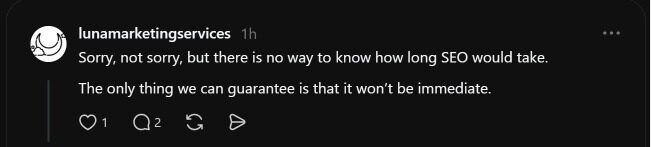
And like everything you post on social media, there is always a chance that someone, somewhere will disagree:

On the bright side, these interactions always bring something good: a chance to talk about the topic properly. So let’s do that.
“My Pages Rank the Next Day”
Well, let’s start by addressing the elephant in the room: SEO is more than just “ranking.” Yes, a new page can be indexed in hours and even rank the next day, especially for low-competition or branded terms. That’s real, and it’s great, but it isn’t the same as having a working strategy.
Being on the first page of Google, Bing, DuckDuckGo, or whoever your favorite search engine overlord is, only matters if the right people see it and do something. For example, we could potentially rank #1 for the search term: “Best way to microwave a sandwich for a cow…” because there is likely no real competition (we hope), but what would be the point of ranking on those terms if nobody really needs to know how to microwave a sandwich for a cow?
SEO is really about being the best answer to a real need at the moment someone has it. Ranking is one visible symptom of doing that well.
Ranking Isn’t the Goal
Well, we are sorry to be the bearers of bad news, but ranking doesn’t equal traffic. Being the #1 matters less than how visible you are, how many clicks you get, and how much business you generate. Ads, featured snippets, and AI summaries can push a #1 result well below the fold, preventing you from getting noticed and getting clients.
Also, traffic doesn’t equal results. Ranking first for “free template” might bring a flood of visitors who never buy anything (because they are literally just looking for the freebie), while ranking #4 for “best accounting software for freelancers” might bring three people a week who become customers. SEO done well starts with intent: who’s searching, what do they actually want, and can you serve them?
Adding to all that, you should always account for the fact that SEO is a whole experience. Search engines are trying to reward pages that satisfy people, so SEO overlaps with site speed, mobile usability, clear writing, trustworthy design, and whether someone leaves your page having gotten what they came for. If you “rank” but people bounce back to the results immediately, you probably won’t hold that spot for long.
Building Authority Through SEO
The whole idea of SEO is not simply to rank first, but to build trust and authority over time: being cited, linked to, and recognized as a credible source in your space… and most importantly, helping you CONVERT.
Think of it as opening a brick-and-mortar shop: if you were to put your shop in a back alley where nobody passes by, chances are you will go unnoticed. If you get the best spot on a busy street, that’s the equivalent of “ranking,” but it doesn’t guarantee you will sell anything. Other factors, starting from what you sell, whether you have a visible sign and if that sign makes sense, whether the door is easy to open, whether the shelves have what people came in for, and whether they leave happy enough to come back and tell a friend, are also part of what will bring you results.
Authority compounds: every useful page, every earned link, and every mention from a credible source makes the next result easier to win. That’s why quick wins on easy terms don’t tell you much about long-term health.
So, How Long Does SEO Really Take?
First of all, let us clarify that when people ask for SEO results, they are rarely asking you for rankings; they are usually asking how long it would take to start seeing business from it…
… and well, as we said in our original post, there is no known way to know exactly how long… there’s no honest single answer, and anyone who gives you one is guessing.
The real timeline depends on how competitive your industry is, how established your site is, the quality of your content, the health of your technical setup, how consistently you keep publishing and improving, your backlinks, and all of those fun SEO things that most people have no real idea of how they work.
In general, early signals like indexing, impressions, and long-tail rankings can show up within weeks. Consistent, qualified traffic and leads usually take months (sometimes even years) to build.
What is the Best Way to Microwave a Sandwich for a Cow?
Honestly, honestly, like HOOOOONESTLY… just open the damn microwave and put the sandwich in. Why are you giving a sandwich to a cow? We are not sure… just as we are not sure why people get overly obsessed over rankings when there are a million other things you should measure to confirm your SEO strategy is working:
- Impressions and click-through rate
- Organic traffic to the pages that matter
- Engagement (time on page, scroll depth, return visits)
- Leads or sales attributed to organic search
- Growth in branded searches over time
Ranking Is the Start, Not the Finish
Making a page rank quickly is possible, and we’re genuinely happy for anyone who gets that result… now, that doesn’t make either side of that Threads conversation wrong: ranking is the easy part to see, not the part that pays the bills.
Think of the shop one more time. Landing on a busy street doesn’t sell anything on its own. What matters is what happens once people notice you.
Meanwhile, somewhere out there, a cow is still waiting on that microwaved sandwich: we could rank #1 for that search term tomorrow (and honestly it will be hilarious if this blog post happens to rank over that term), and the cow would be delighted… but chances are our revenue would not.
Ranking gets you on the street. SEO is what makes people walk through the door. (The cow, sadly, is still stuck at the microwave.)