
Today’s blog post is brought to you by a very dense cold outreach email.
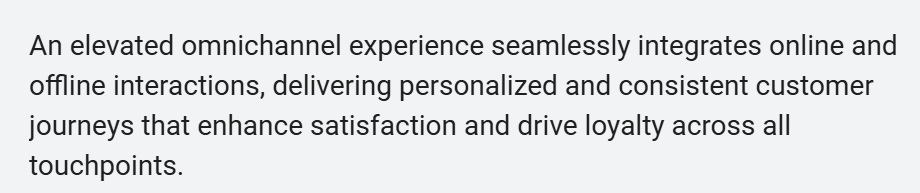
Yeah, we did not screenshot the whole email, but that is the intro paragraph… THE. INTRO. PARAGRAPH. And don’t get us wrong, we understood it (sort of, after reading it 3 times), but it was kind of… dense (FYI, they were trying to pitch us a guest post for our blog).
It’s been a very busy couple of weeks with plenty to do and pending items, and, honestly, reading that gave us a headache. It did make us stop, yes, but not in a good way. It actually made us wonder… who would read that?
And then it clicked: the topic was not the problem. The wording was. “Elevated omnichannel experience” is not a phrase you hear in a regular conversation with a client, or a friend, or family… Really, not even in our 10 years of marketing and planning meetings have we heard someone use that exact phrase so technical…
Your word matters as much as your message.
And again, the message was there, it was understood, but it was dense… and that is the thing about communication that a lot of businesses tend to overlook: it is not just what you say, it is how you say it. You can have the most brilliant idea, the most valuable service, the most compelling offer, and still lose people in the first sentence if the words you choose don’t connect with them.
So let’s talk about that.
Who Are You Actually Talking To?
This is the question that should come before any piece of content you write, any email you send, any caption you post. Not “what do I want to say?” but “who am I saying it to?”
Because here is the thing: your audience is not your industry. Your audience is not your colleagues, nor your peers, nor the people who already know the terminology. Your audience is the person on the other side of the screen who found you, is giving you a few seconds of their attention, and needs to understand you before turning their attention to the next thing on their feed.
If you are a marketing agency talking to small business owners, you are not talking to marketers. You are talking to someone who is probably also managing inventory, handling customer service, posting on social media between meetings, and trying to figure out how to grow without burning out. They do not have time to decode dense vocabulary. And more importantly, they should not have to.
Sounding Smart vs. Being Understood
There is a common misconception that using technical language makes you sound more credible. And look, in some contexts it does: if you are writing a white paper for industry professionals, go for it. But in most everyday business communication? It creates distance, not authority.
Think, for example, of when you go to the doctor: what would you understand better? The doctor telling you you are “presenting with cephalalgia secondary to suboptimal systemic hydration status, likely precipitated by mild extracellular fluid volume depletion and transient osmotic disequilibrium associated with inadequate oral fluid intake” or if they told you: “you are dehydrated, and that is why your head hurts?” probably the second one, no?
The brands and people you actually enjoy following online, the ones whose emails you open, whose posts you stop to read, whose content you save to come back to later. Chances are, they do not sound like a corporate press release or a technical document. They sound like a person: a knowledgeable, trustworthy, interesting person — but a person nonetheless. That is not an accident. That is a very intentional choice.
The goal is not to dumb things down. The goal is to make things clear. There is a big difference between the two, and it is worth remembering that clarity is actually a sign of confidence. When you truly understand something, you can explain it simply. When you are not quite sure, you hide behind complexity.
Practical Ways to Simplify Without Losing Substance
So how do you actually do this? A few things that help:
1. Read it out loud.
If you stumble over a sentence while reading it to yourself, your audience will stumble over it too. If it sounds like something no one would ever actually say in a conversation, rewrite it.
2. Replace jargon with plain language.
“Elevated omnichannel experience” can simply be “a consistent experience no matter where your customer finds you.” Same idea. Half the syllables. Ten times more accessible. Ask yourself: would my best customer understand this immediately? Not after reading it twice. Not after Googling a term. Immediately. If the answer is no, simplify.
3. Cut the fluff.
Business communication has a habit of adding filler phrases that sound important but add no meaning: “in today’s fast-paced landscape,” “at the end of the day,” “moving the needle.” Your readers notice (and sometimes will even think it was written with AI because who the heck uses “landscape” on copy if they are not a landscaping company!?), even if they can not always name why it feels off. Get to the point.
4. Write like you talk.
This one sounds like super generic, overused advice that every other marketer and internet guru will tell you. Still, it is especially relevant for small businesses because one of your biggest advantages over larger brands is your personality: you have a voice, a story, a reason why you do what you do. Let that come through. A little warmth goes a very long way.
Your Words Matter
Your message only works if it reaches people, and it can only reach people if they actually understand it, connect with it, and feel like it was written for them.
The pitch we received wasn’t bad because the topic was wrong, but because it assumed the jargon was okay for whoever was on the other side of the email, saying, “We are reaching an agency; they should know.” And that is a mistake anyone can make, which is exactly why it is worth paying attention to.
So the next time you sit down to write something, a caption, an email, a blog post, a pitch, pause for a second before you start typing. Think about the person reading it. Think about how they talk, what they care about, and what kind of day they are probably having. And then write for that person.
Because at the end of the day, the best marketing does not sound like marketing at all. It sounds like a conversation. And conversations, by definition, require both people to understand each other.